“I can see you in the morning when you go to school; Don’t forget your books, you know you’ve got to learn the golden rule.” ~ “School”, Supertramp
For the uninitiated, “adaptive reuse” most often entails repurposing a building for a new use that differs from the use for which it was designed. One of my favorite examples of that practice is in my hometown of Niagara Falls, New York. In 2016, New York City-based developer CB-Emmanuel Realty LLC tackled the historic rehabilitation of South Junior High School, in the city’s downtown core, and it was no easy task.
While historic school buildings generally convert relatively easily to apartments, the condition of South Junior was dire by the time CB-Emmanuel commenced its adaptive reuse project, greatly increasing construction costs and challenges. In my role as an historic preservation professional, I’ve toured dozens of school buildings, many of which were in unsafe condition. Very few, though, required a HEPA mask simply to safely enter, as South Junior did. The level of preparatory remediation the 115,000 SF building demanded was staggering.
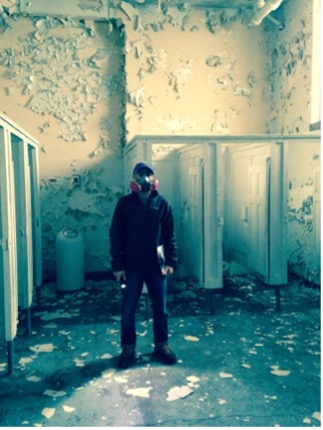
CB-Emmanuel thankfully was fit for the task, and they saved the building from a planned $1.2 million demolition. By 2018, the company spent $24 million to convert South Junior into 61 affordable apartments (including 11 special-needs/veteran units), a community center, and amenity spaces. Notably, the “capital stack” for the project included both historic tax credits and low-income housing tax credits, attracting significant private investment to a very poor area of New York State.
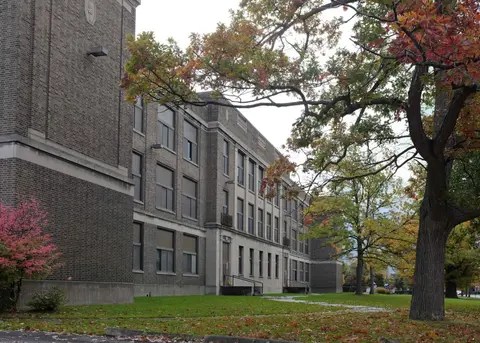
Photo credit: Niagara Reporter
While impressive on its own, the salvation of South Junior is near and dear to my heart because I attended the school as part of its last class of seventh graders in 1983-84. Back then, “junior highs” often included grades seven to nine, and the chasm between those age groups in the early 1980s was vast. Incoming seventh graders were mere children among the mustached and busty young adults who smoked and made-out in our bathrooms.
For seventh graders, danger was everywhere. During the first few months of Fall 1983, there were multiple gang fights in the school’s faculty parking lot, a classmate was rolled down a flight of stairs in round metal garbage can, another kid was tossed pants-down into the girls’ locker room, and a friend was jumped by a gang of older kids on the walk home one day. They broke his nose, so his parents moved him to Catholic school over Christmas break.
As for me, I managed to get into three fights that year and was suspended from school for one of them. In my limited defense, I was suspended for pounding a kid who was bullying my much smaller friend, but my parents didn’t share my sense of valor, and they came down hard on me. First semester, my record was one win, one loss, and a reluctant draw. For general protection, I carried an extra combination lock in my right hand to and from school every day for most of the year.
For better or worse, my time at South Junior would be short-lived. By the early 1980s, Niagara Falls was shrinking fast. In 1960, the city’s population peaked at 102,394. By 1980, the population had dropped to 71,384.[1] At that point, the city had four junior high schools. By the time I entered South Junior in 1983, one of those junior highs had already closed. Unbeknownst to me, South Junior would be the next to close, as I was dismayed to discover in early 1984.
But we’ll save that story for Part 2 …
[1] It continues to free-fall, having dipped below the 50,000-resident threshold for “city” status in New York State as of the 2020 U.S. census.


Leave a Reply